
SEO services SEO built on a technical foundation.
Search visibility starts with a site search engines can crawl, understand and trust. Vioniche fixes the technical layer first, then builds the content structure and monitoring that let visibility grow over time.
SEO is not adding keywords.
A page Google cannot crawl, or one competing with three copies of itself, will not rank however well it is written. Many SEO problems are website problems first.
- 01
Pages that cannot be found
Missing from the sitemap, blocked by robots rules, or only reachable through a script search engines do not run.
- 02
The same page at several addresses
www and non-www, with and without a trailing slash, with tracking parameters — splitting one page’s signals several ways.
- 03
Metadata that says nothing
The same title on every page, or none at all, so search results cannot tell people what a page is.
- 04
No structure
Pages with no clear relationship to each other, so neither search engines nor visitors can tell what matters most.
From foundation to visibility.
Each layer depends on the one before it. Content on a site that cannot be indexed is wasted, and visibility that is not measured cannot be improved — so the last step loops back to the first.
- 01Technical foundationCrawlable, indexable, fast
- 02Content architecturePages mapped to what people search
- 03Search visibilityPages shown for relevant searches
- 04Ongoing optimisationMeasured, improved, repeated
Technical, on-page and content.
One person responsible for the whole of it, so a content plan never runs into a site that cannot support it.
Technical SEO
Making sure search engines can crawl, render and index the site, and file each page under the right address.
On-page SEO
Titles, descriptions, headings, image text and internal links written for what each page is for.
Site architecture
A URL structure, navigation and page hierarchy that make the important pages obvious.
Keyword & topic research
The terms customers actually use, the intent behind them, and which page should answer each.
Content strategy
Which articles and pages to write, in what order, and how they link to each other and to your services.
Monitoring & optimisation
Search Console set up and read regularly: coverage, indexing issues, queries and what to fix next.
Making the site readable to search engines.
Before content can rank, search engines have to find it, read it and file it under the right address.
- 01
XML sitemap
Every page and published article listed, generated at each build with real last-modified dates, and submitted to Search Console.
- 02
Robots rules
Search engines allowed where they should be and kept out of what is not a page — forms endpoints, admin areas.
- 03
Canonical URLs
Each page names its one preferred address, so duplicates do not compete with each other.
- 04
Indexing
Coverage reports checked for pages Google has excluded, with the reason found and fixed.
- 05
Structured data
Schema that describes the page accurately — organisation, article, breadcrumb — and nothing the page does not show.
- 06
Metadata
A unique title and description per page, written for the result someone sees, within the length search engines display.
- 07
Performance
Fast-loading, stable pages, especially on mobile, where most searches now happen.
- 08
Redirects
Old and changed URLs pointed at their new addresses, so links and history carry over.
Content planned around real searches.
Keyword research finds the words customers use. The more useful part is the intent behind them — whether someone wants to learn, compare or hire — because that decides what kind of page should answer the search, and where it belongs on the site.
This site’s own blog works this way. Its editor shows an SEO check for every article — title and description length, heading structure, image text, primary keyword and internal links — before it is published, as with Why Your Business Needs a Modern Website in 2026.
- Search intent first
- Each page is planned around what the person searching wants — to learn, compare, or hire — before a word is written.
- Topics, not single keywords
- Related questions grouped into clusters, with a main page and supporting articles that link to it.
- Briefs before drafts
- A brief for every piece: the question it answers, the terms it should use naturally, the pages it links to.
- Checked before publishing
- Titles, descriptions, headings, image text and internal links reviewed on every article before it goes live.
Measured, not assumed.
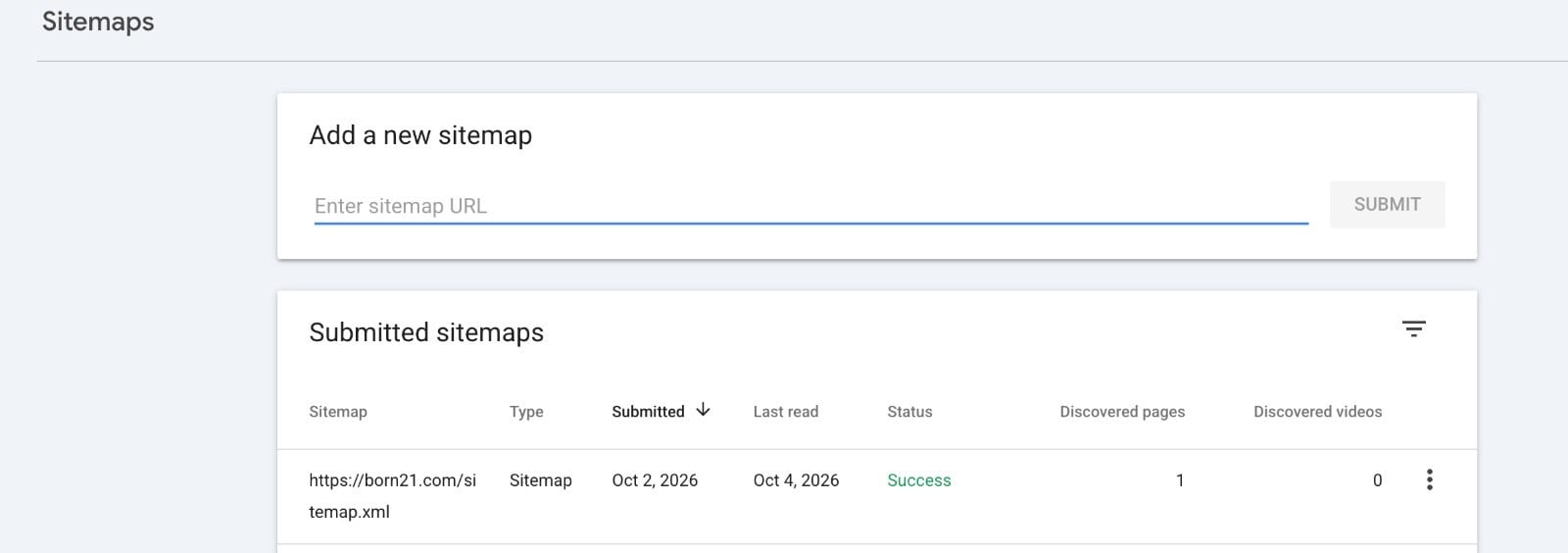
Google Search Console shows which pages are indexed, which were left out and why, and which searches the site appears for. It is set up on launch, its sitemap is submitted, and its reports are read regularly — they decide what gets fixed or written next.
Reporting covers what actually changed, including when the answer is “not much yet”.
A cycle, not a launch.
The audit decides the order. Technical problems are fixed before content is written, because they limit everything built on top of them.
- 01AuditCrawl, index and metadata review
- 02Fix the foundationTechnical issues first
- 03Map contentPages and topics to search intent
- 04Publish & optimiseNew and improved pages
- 05MonitorSearch Console, every month
- 06ImproveAct on what the data shows
Not sure what is holding your site back in search?
Talk About Your SEOThe Born21 SEO foundation.
See how Vioniche built Born21’s website and technical SEO foundation: a sitemap generated at every build from published Ghost articles, canonical URLs and written metadata for each page, and Search Console set up to monitor how Google picks it up.
As the case study says, search performance is being measured over time before any growth is claimed.
- Sitemap
- Generated at each build, submitted and processed in Search Console
- Canonicals & metadata
- One preferred address and a written title and description per page
- Content workflow
- Research, search intent and structure before publishing in Ghost
- Monitoring
- Indexing and sitemap status followed in Search Console
Straight answers about SEO.
If yours is not here, ask it in the form below — you will get a straight answer.
How long does SEO take to work?
Technical fixes can be picked up as soon as Google recrawls the affected pages, which is often days or weeks. Visibility for competitive searches usually takes months of consistent content and improvement. Anyone who promises a date for a ranking is guessing.
Can you guarantee first-page rankings?
No — and be wary of anyone who does. Rankings are decided by search engines and depend on your competitors, your content and time. What Vioniche commits to is the work: a sound technical foundation, a clear content plan, and honest reporting from Search Console on what is changing.
Do you work on websites Vioniche did not build?
Yes. It starts with an audit. Some fixes depend on what the platform allows; if a site cannot support them, you will be told plainly, along with the options — which sometimes include a rebuild through web development.
Do you build backlinks?
The focus is the site and its content — the parts you control and that earn links over time. Vioniche does not buy links or run link schemes; they put a site at risk of penalties.
What about AI search and AI answers?
Clear site structure, accurate structured data and genuinely useful content are what search engines and AI answer tools both read. That is the work done here. No one can guarantee that a site will be cited in AI-generated answers.
What do you need from us?
Access to the website or its CMS, access to Google Search Console (or permission to set it up), and some time to talk about your customers and what they ask before they buy.
SEO works best with the rest.
Web Development
A fast, well-structured site is where technical SEO starts — and the cheapest point to get it right.
Explore web development Less manual workAutomation
Publishing, sitemap updates and reporting that run on their own, so the SEO routine keeps going.
Explore business automation ReadThe Vioniche blog
Articles on websites, SEO and digital growth, written for business owners rather than specialists.
Read the blog